
Why Below-Grade Waterproofing Matters
Below-grade waterproofing is the most important thing you bury. It is also the thing most likely to be undervalued during budgeting, value-engineered into something cheaper, or rushed at the end of a foundation pour because the schedule's tight and the next trade is waiting.
That's a problem, because below-grade waterproofing is the line between a building that performs for fifty years and one that has water in the basement after the first wet winter — and once the wall is backfilled, the only way to fix a failure is to dig it back up.
This article explains why below-grade waterproofing is critical on commercial buildings, what happens when it's done poorly or skipped, why sheet membranes like Henry Blueskin® WP200 have become the standard for serious commercial work, and how to think about specifying it on your next project.
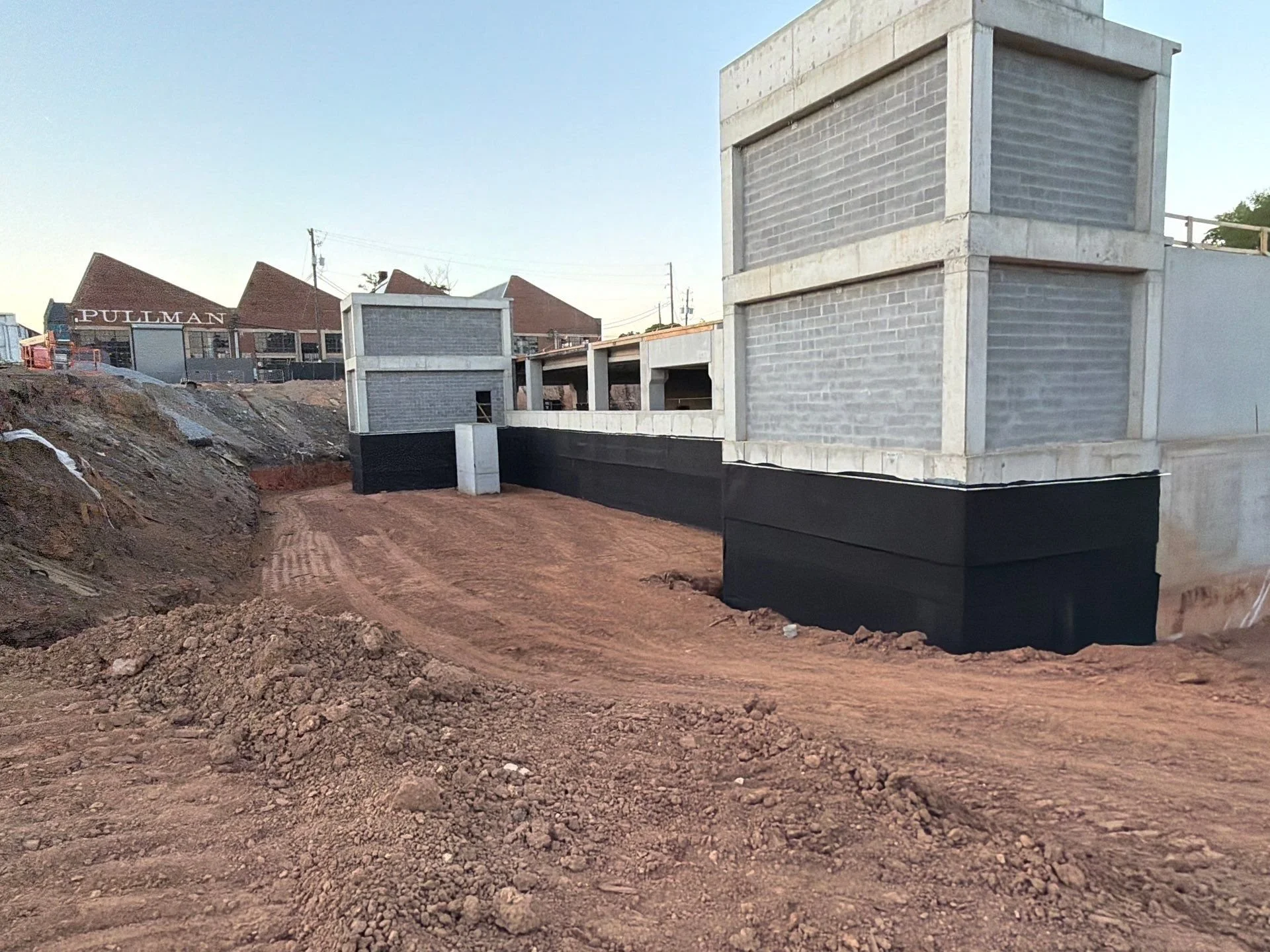
Henry Blueskin WP200 below grade waterproofing system partially backfilled on a precast parking garage
What is below-grade waterproofing?
Below-grade waterproofing is a continuous, fully sealed barrier installed on the exterior side of any concrete structure that sits below finished grade — foundation walls, retaining walls, elevator pits, parking garage walls, plaza decks, planter walls, and the like. The barrier blocks liquid water and water vapor from migrating from the surrounding soil into the structure.
It is not the same thing as damp-proofing, which is the tar-like coating you see on residential foundations. Damp-proofing slows water vapor; it does not stop liquid water under pressure. On commercial construction, anything below grade should be waterproofed, not damp-proofed. Confusing the two is one of the most expensive mistakes in commercial construction.
A complete below-grade waterproofing assembly typically includes:
-
Sheet, fluid-applied, or hybrid) bonded to the concrete substraten text goes here
-
Drainage composite or board — installed over the cured membrane to shield it from backfill damage
-
At all transitions: footings, slab edges, columns, pipe penetrations, expansion joints, and tie-ins to above-grade air and water barriers
-
At the top and bottom of the membrane to lock the system off cleanly
Skip or shortcut any of these and the system underperforms. The membrane itself is only one component.
Why is below-grade waterproofing so important?
There are four reasons, and all four are about money and time.
1. The hydrostatic pressure problem. Groundwater doesn't just sit next to a foundation wall — it pushes against it. Hydrostatic pressure builds with the height of the water column behind the wall and is constant 365 days a year. A wall that sees 10 feet of standing water on the soil side is being pushed by more than 600 pounds per square foot at the bottom of that water column. Concrete is porous; without a waterproofing membrane, that pressure forces water through hairline cracks, cold joints, tie holes, and any other discontinuity in the concrete. There is no "drying out" of a wall under continuous hydrostatic load.
2. The vapor problem. Even where there's no standing groundwater, soil is humid. Water vapor migrates through concrete by diffusion, ends up in the conditioned interior of the building, and shows up later as efflorescence on walls, mold inside finishes, corrosion of embedded steel, and elevated relative humidity that the HVAC system has to fight. A proper waterproofing membrane is also a vapor barrier — it solves both problems at once.
3. The repair access problem. Above-grade leaks can be diagnosed and fixed from the inside or the outside. Below-grade leaks can only be fixed by either (a) excavating the wall back down to the footing — which on a finished site can cost more than the original waterproofing scope by an order of magnitude — or (b) interior negative-side repairs, which never perform as well as the original membrane should have. The membrane you install on day one is functionally the only chance you get.
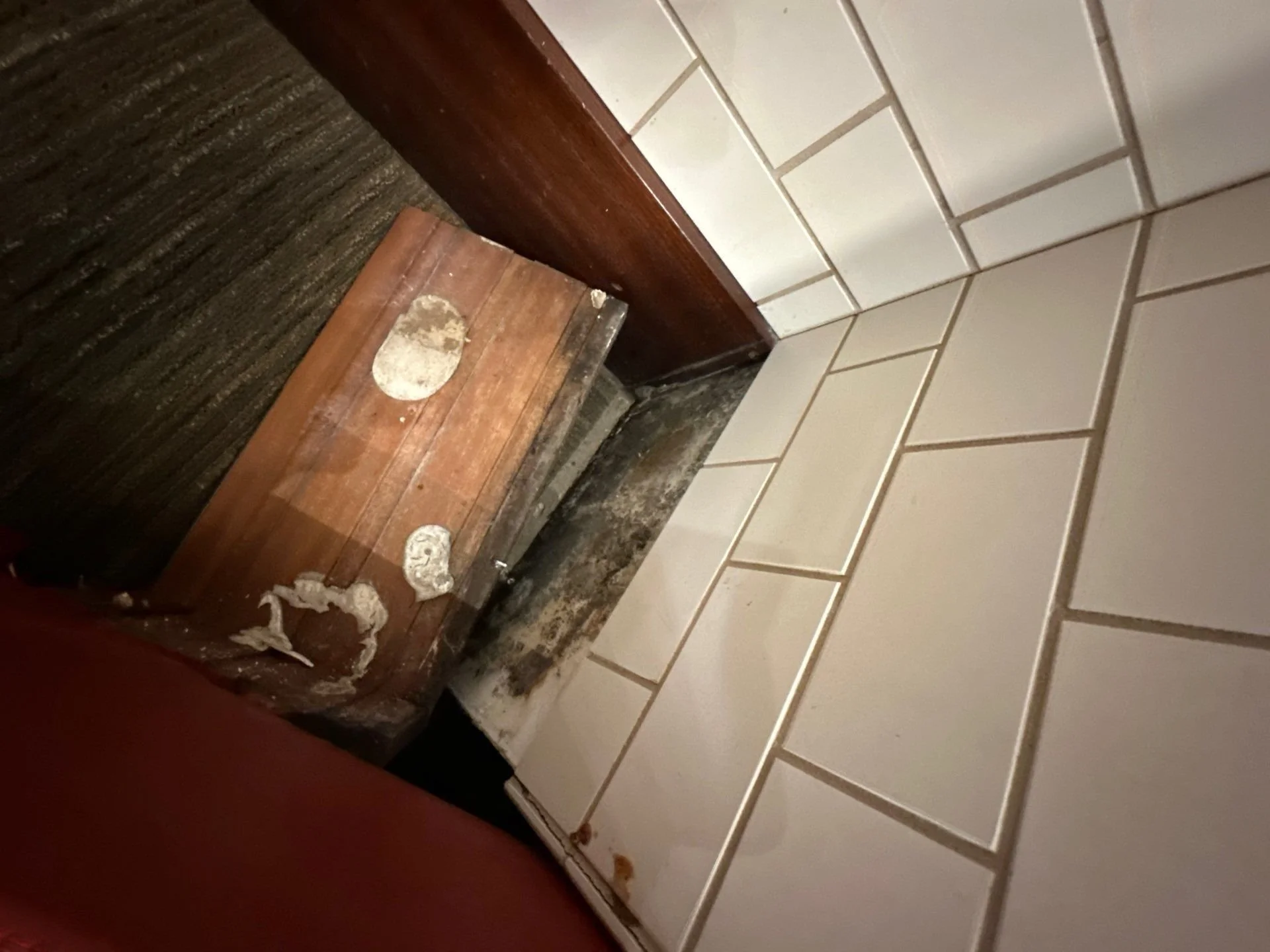
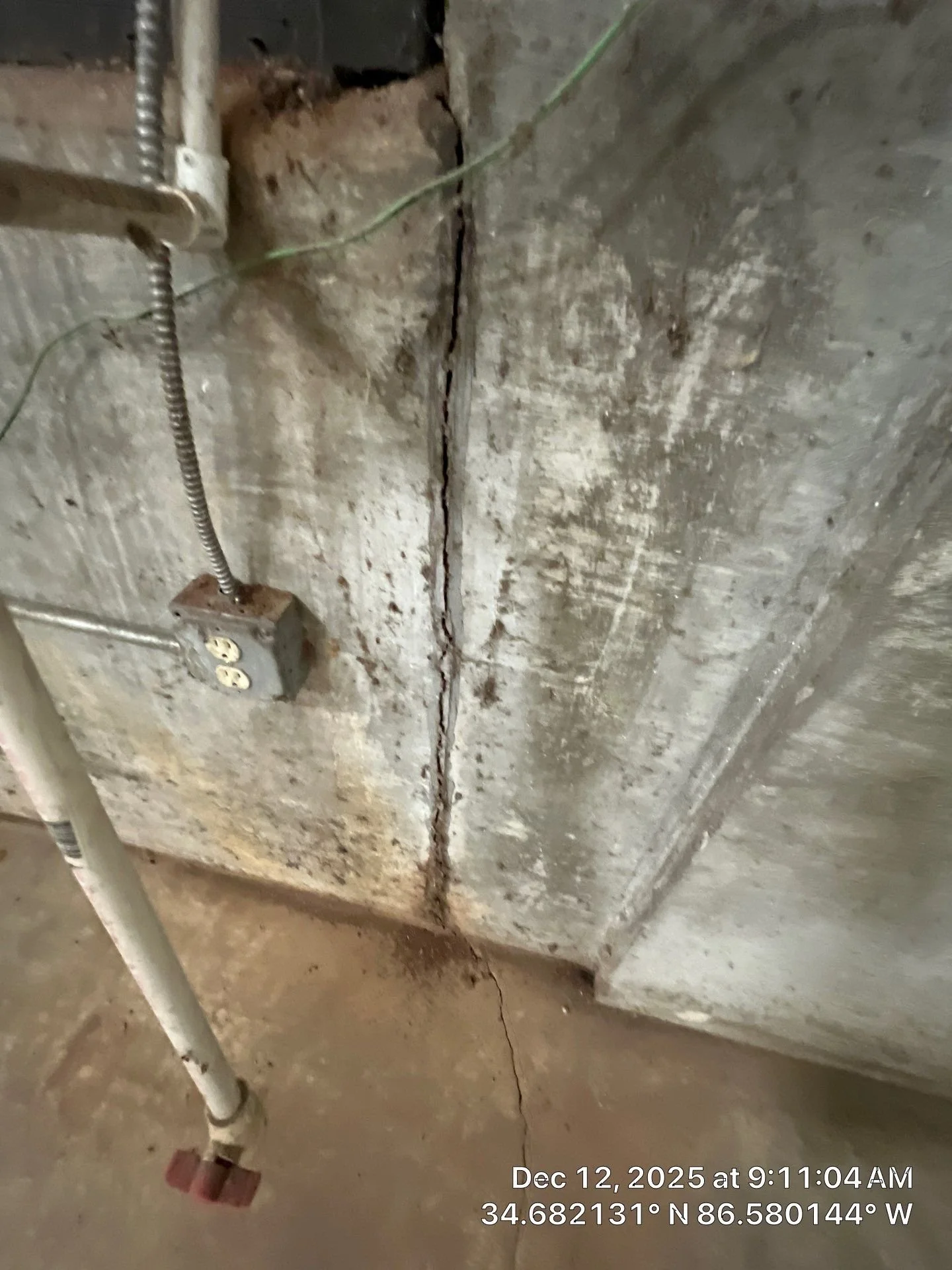
4. The damage cascade. A below-grade leak is rarely just a wet floor. Water in the foundation corrodes embedded rebar, which expands as it rusts, which spalls the surrounding concrete, which exposes more rebar. Water also wicks into adjacent finishes, into electrical conduit, and into structural slabs. By the time the leak is visible on the inside, the damage behind the finish materials can be five or ten years old. The repair scope balloons accordingly.
The takeaway: the membrane installed correctly the first time is always cheaper than the repair, often by a factor of 20-50x on a commercial project.
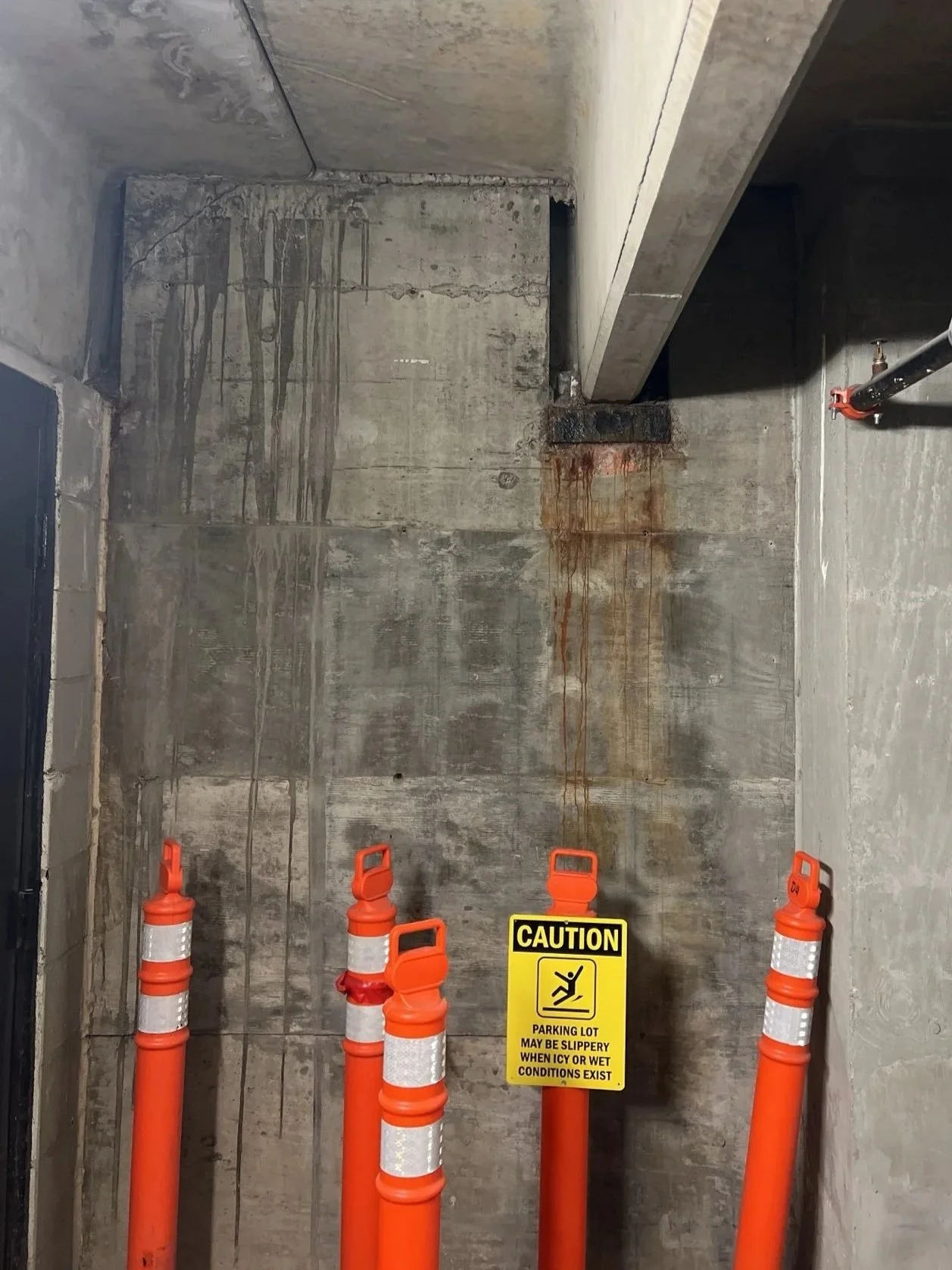
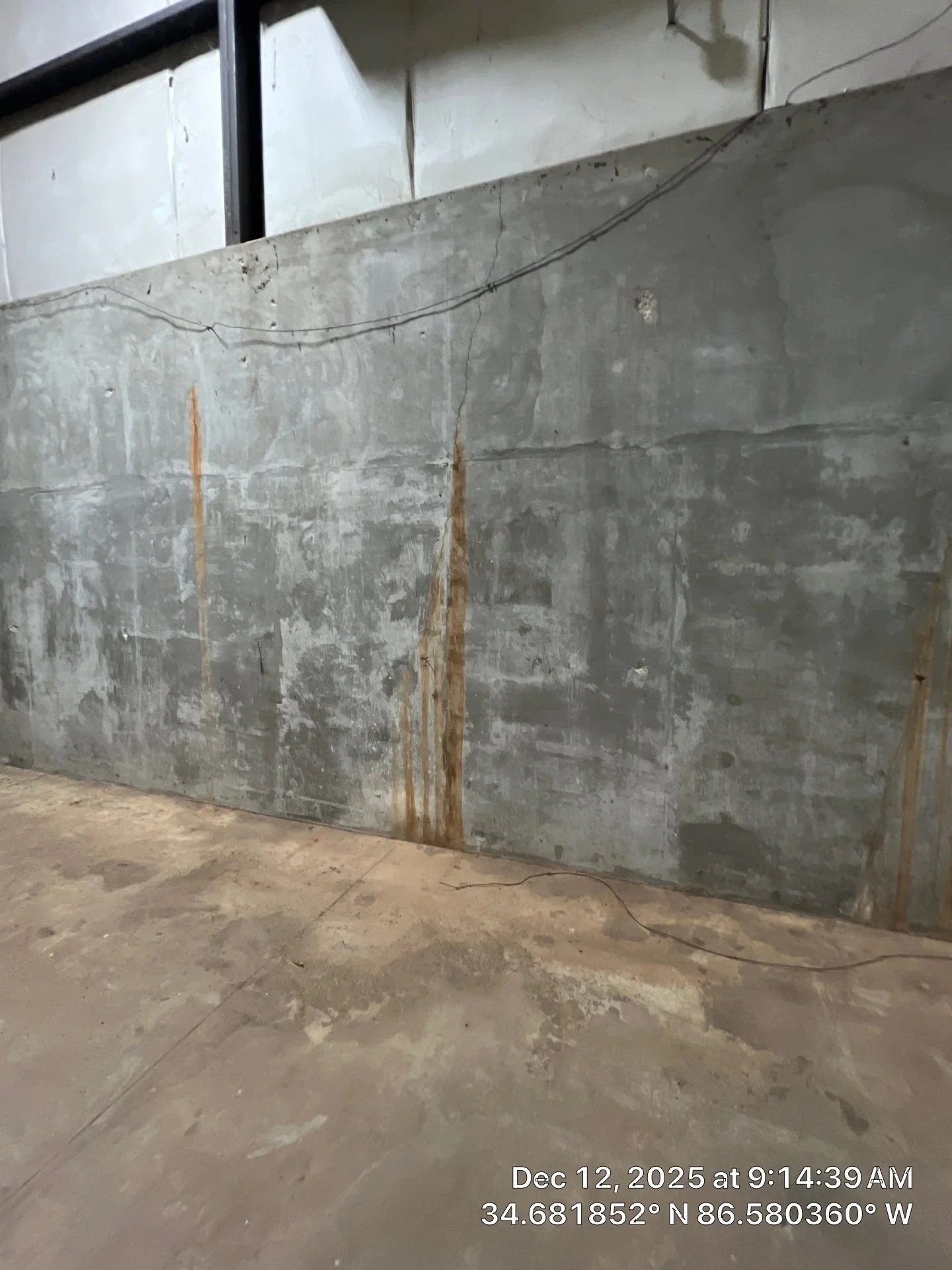
This is the interior of a parking garage wall where the below-grade waterproofing failed. The vertical staining is water tracking through unsealed cold joints, the orange streak is rust bleeding from a corroded steel embed, and the white deposits are efflorescence — mineral salts leached out of the concrete by moving water. Every bit of this damage was preventable with a properly installed waterproofing system on day one.
What happens when below-grade waterproofing fails?
In our experience, failures fall into a few predictable categories:
Adhesion failures are the most common. Sheet membranes get installed on substrates that are too dirty, too cold, too dusty, or too wet to bond properly. The membrane looks installed but isn't actually adhered. Water finds the gap and travels laterally under the membrane until it finds a seam or a tie hole and enters the building. Lateral water migration is the worst kind of below-grade leak because the entry point on the interior is rarely anywhere near the actual breach in the membrane — which makes diagnosis nearly impossible.
Termination failures happen at the top and bottom of the membrane. If the membrane isn't locked off at a counterflashing or a termination bar at the top, water sheets down behind it. If the bottom isn't detailed properly to the footing, water enters at the wall-footing cold joint and travels into the slab.
Penetration failures happen where pipes, conduit, sleeves, and anchors pass through the wall. Each penetration is a potential leak path and needs to be sealed with the manufacturer's published detail — typically a reinforcing patch and a sealant collar. Crews that don't know the details, or that skip them under schedule pressure, create dozens of potential leak points per wall.
Backfill damage happens when the protection course is missing or undersized and rocks puncture the membrane during backfill. This is the easiest failure to prevent and one of the easiest to skip.
Substrate moisture failures happen when sheet membranes are installed on damp or "green" concrete. Self-adhered membranes need a clean, dry substrate to bond — when groundwater or recent rain keeps the concrete saturated, the adhesive can't grip the surface, the membrane blisters, and water finds its way back through.
The good news: every one of these failure modes is preventable with the right product specification, the right installer, and conditions-aware field judgment. None of it is mysterious.



When does a project need below-grade waterproofing?
Whenever any part of a structure is built below ground level it needs below-grade waterproofing. The most common applications:
Foundation walls on commercial buildings with basements, occupied lower levels, or below-grade mechanical rooms
Parking garage walls on multi-level structures with subgrade levels
Elevator pits — small in area but disproportionately important because a leaking pit floods the elevator mechanicals
Plaza decks and split-slab assemblies where occupied space sits beneath outdoor walking surfaces
Planter walls in landscaped courtyards and rooftop gardens
Retaining walls when interior dry space sits behind them
Mechanical vaults and underground utility chambers
Pools and water features below grade
If you're not sure whether your application qualifies, the rule of thumb is: if there is dry interior space on one side of the wall and earth on the other, the wall needs waterproofing.
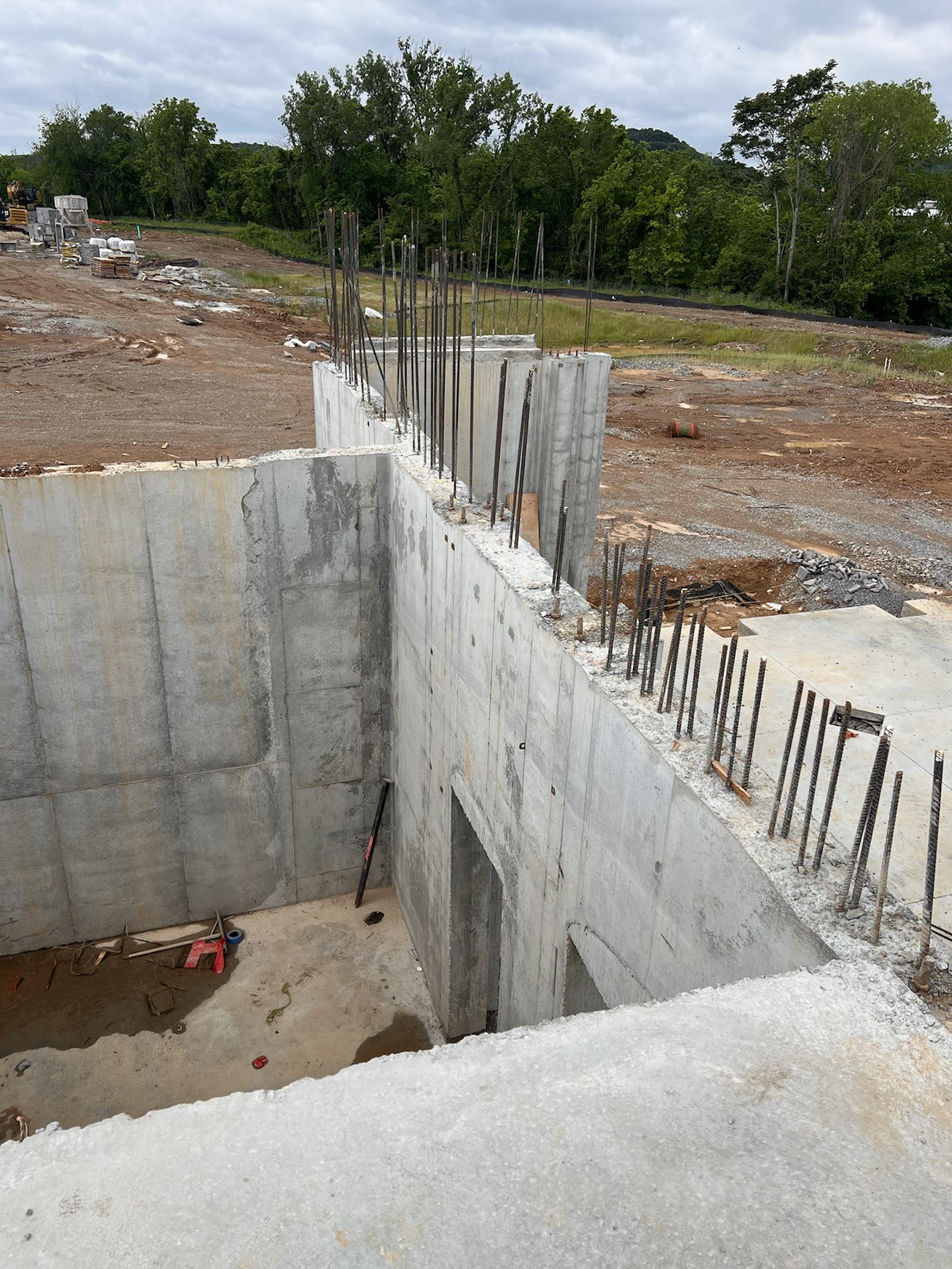
Cast-in-place concrete walls of a new commercial below-grade level, freshly stripped and ready for the next stage of construction. Walls like these — full-height, bare concrete, soon to be backfilled — are exactly where below-grade waterproofing belongs. The membrane goes on now, before the dirt does. Once the site is backfilled, the only way to fix a waterproofing problem is to dig it back out.
How long does below-grade waterproofing last?
A properly installed below-grade waterproofing assembly should perform for the design life of the building — 50 years or more — without intervention. The membrane itself is engineered for that lifespan, and the manufacturer's long-term warranty backs the materials.
Workmanship is the variable. The membrane outlasts the contractor's workmanship warranty almost every time, which is why installer selection matters as much as product selection. A name-brand sheet membrane installed by a crew that doesn't know the details will fail. A serious commercial waterproofing contractor installing the same product will deliver a system that performs for the life of the building.
What should you look for in a below-grade waterproofing contractor?
Five things, in order of importance:
Manufacturer approval. Henry, Tremco, Dow, and Sherwin-Williams all maintain lists of approved installers. Approved installers have been trained on the manufacturer's published details and can carry the manufacturer's extended warranties. Working with a non-approved installer means you're getting workmanship-only coverage, not the materials warranty that the spec assumes.
Specialization. Roofers do roofs. General contractors manage projects. Waterproofing contractors specialize in waterproofing. A specialist crew installs WP200 every week — they know the details, they know what to do when the concrete's wet, and they know which transitions matter most. A generalist crew installing waterproofing once a year is going to make mistakes you'll find out about three winters later.
References on similar projects. Below-grade waterproofing on a parking garage is different work from below-grade on a residential basement. Ask for project references at similar scale and complexity. Ask whether the owner has had any leaks since.
Conditions-aware bidding. A contractor who bids a job based on perfect-world conditions and refuses to adapt when the field tells a different story is a contractor who will value-engineer the system into failure. The right contractor walks the site, looks at the concrete, asks about the water table, and proposes the assembly that fits the actual conditions — not just the bid set.
Insurance, licensing, and direct accountability. Standard, but worth verifying.
What does it cost to do below-grade waterproofing right vs. wrong?
The honest answer: a properly specified, properly installed below-grade waterproofing system is one of the lowest-cost components on a commercial building relative to its function. Membrane material costs are modest. Installation labor is the largest line item, and even that scales linearly with wall area. On most commercial projects, the entire below-grade waterproofing scope runs a single-digit percentage of the foundation budget.
The cost of not doing it right is exponential. Excavating a finished site to repair a leaking foundation can cost more than the original waterproofing scope by an order of magnitude. Interior repairs — drying out finishes, replacing damaged drywall, treating mold, restoring electrical, repairing structural concrete corrosion — frequently exceed the cost of excavation. And those numbers don't count business interruption for occupied space.
The math is rarely close. Specifying a real membrane system, installing it correctly the first time, and paying for proper detailing is the cheap option, even when it doesn't feel that way in the bid review.
Talk to a below-grade waterproofing specialist
Performance Waterproofing LLC is a commercial waterproofing contractor headquartered in Nashville, Tennessee, serving general contractors, developers, and property owners across the Southeast — Tennessee, Georgia, Alabama, Kentucky, and the surrounding region. We are an approved installer for the full Henry waterproofing system, as well as for Tremco, Dow, and Sherwin-Williams products.
If you have a below-grade, parking garage, foundation, plaza deck, or elevator pit project on the boards and want to talk through the right system for your conditions.